Session A.2
jump to: Spotlight on UUs Did you know? For our next session
Hands-on learning: breakfast recipes
Get ready to cook together!
PREPARATION
1. Read this session all the way through. Scripted language in highlighting is offered as guidance; feel free to deviate as you see fit.
2. Find out: will you be able to use washable plates and utensils from the congregation? If not, consider asking participants to bring their own, to avoid creating more garbage.
3. Find out: does your congregation collect food waste for composting? If not, you can suggest that as a worthy Exit Ticket project for your group to consider. In the meantime, if you have your own compost pile (or if you know someone who does), please bring a large container to this session, so you can ask participants to divert kitchen scraps or unwanted food into the container for composting.
4. Mid-week, send reminder email with link to the assigned viewing. Here is a template for your email. The email asks participants to note place-of-origin information about their ingredients, so they can share that information with the group during the session.
5. Check in with each cooking group leader to make sure their group will have necessary ingredients and equipment.
6. Designate at least two people to take some pictures.
7. Ensure there will be nametags, and create signage to help participants find kitchen, if necessary.
8. Make copies of each recipe for A.3 (printable versions here)—assemble a set of recipes for each participant.
9. On an index card, write the table grace provided below.
Welcome, check-in, mealtime blessings (10 minutes)
Say, Welcome back! We're going to prepare and share a meal today. Before we get cooking, let's go around the circle to check in about our week. I'll start... Model a brief check-in, and let each participant take a turn doing the same.
For some people, it is a tradition to pause before they eat, to give thanks or say a blessing. The curriculum suggests we try it, since we'll be eating together. Did any of you grow up saying grace at the table? What could be some benefits of practicing this custom? Let participants respond.
Here is the table grace provided by the curriculum:
For the many people, near and far,
who plant and pick and deliver our food,
We give thanks.
For the earth and rain and sun that sustain us,
We give thanks.
For this day, this meal, and this joyful time together,
We give thanks.
Would someone volunteer to read this when we sit down to eat? And the rest of us can join in to say "We give thanks" responsively. Give index card to volunteer.
One more thing: did you remember to bring your place-of-origin information? Great. If not, most of your ingredients will still be in packaging that tells you, so you can make your list now. Who brought the peeled frozen banana pieces? Did you make note of the country of origin? If you have to guess, they're probably from Guatemala, Ecuador, or Costa Rica.
If your group doesn't know the origin of every ingredient, no problem. We're going to do this again next time. It's just an exercise in appreciation, to get us thinking about where our meal is coming from. Now let's get cooking!
Cooking together (30-40 minutes)
Have fun, be safe, and don't worry about errors. When working together in the kitchen, remember this motto: Let's be flexible and forgiving. (Not a bad motto for life in general.☺) And take pictures. And please compost the food scraps and waste.

Berry-Banana Smoothie
When DOVE co-author Jennifer Greene served as an activities leader at Sophia Fahs UU Religious Education Camp (Shelter Island, NY), her fruit smoothie workshops filled up quickly with children and youth who loved experimenting with different combinations and tasting their creations.
You will need a blender.
For your class, multiply this single-serving recipe accordingly:
½ cup your choice of dairy-free milk (vanilla, chocolate, or plain? Whatever you prefer!) or fruit juice (such as calcium-fortified orange juice)
¾ ripe frozen banana (peeled, broken into chunks, placed in bag or container and stored overnight in freezer)
¼ - ½ cup frozen berries (any ones you like: blueberries, strawberries, raspberries, blackberries, cherries)
Place banana chunks in blender with enough milk to blend until smooth. Add berries, and continue blending. Add water if needed, to thin to desired consistency.
Feeling adventurous? Try adding a fistful of fresh spinach, or a few stalks of kale. Some people love green smoothies as a way to increase their intake of leafy green vegetables.
Kitchen tip: Any time you have fruit that is nearly over-ripe, cut it into pieces and store in the freezer for future smoothie-making. Enjoy trying different flavor combinations.
Nutrition note: calcium-fortified plant milks or fruit juices can provide as much or more calcium per serving as cows' milk. Check the nutrition label.
Ben Franklin Scramble
This recipe is from How to Eat like a Vegetarian Even If You Never Want to Be One by Carol J. Adams and Patti Breitman. (They call it Scrambled Tofu.)
Why name scrambled tofu after Benjamin Franklin? Historians believe he was the first person in North America to document tofu-making. In 1770, he sent a letter to John Bartram including instructions for making a cheese called "tau-fu" from "Chinese caravances" (soybeans). Today, tofu appears on the menu at Philadelphia's City Tavern.
For your class meal, one recipe may be enough for three participants, so multiply accordingly.
1 tablespoon olive oil (or try an oil-free version by sautéing in vegetable broth or water)
3 garlic cloves, minced
8 to 10 medium mushrooms, sliced
½ cup grated carrots
½ cup chopped scallion
¼ teaspoon turmeric
3 tablespoons nutritional yeast
1 pound regular firm tofu, crumbled
1 tablespoon soy sauce
1 cup spinach leaves
1. Heat the oil (or other liquid) over medium-high heat, then sauté mushrooms and garlic until they are golden on one side.
2. When you flip the mushrooms and garlic over, add the carrots and scallion. Sauté them together for about 2 minutes.
3. Add the tofu, nutritional yeast flakes, turmeric, and soy sauce. Stir them together, and continue cooking for about 5 minutes.
4. Add spinach and let cook for about one minute. It will become slightly wilted but still hold its shape.
Serve unaccompanied, or with toast, or wrapped in tortillas.
This is a flexible recipe. If you don’t include all the vegetables, it will still be delicious. Or you can add in other favorites.
Apple-Cinnamon Muesli
A simple, delicious recipe adapted from "The Chef and the Dietitian" video series. (Click here to view the video.)
Makes one full bowl. For your class meal, one recipe may be enough for 2-3 participants, so multiply accordingly.
½ cup rolled oats
2 tablespoons currants or raisins
1 tablespoon chia seeds (You might know about chia pets... Turns out the seeds are good to eat.)
½ teaspoon apple pie spice or plain cinnamon
¼ cup your choice of dairy-free milk
1 teaspoon vanilla extract (optional—muesli will still be delicious without this)
1 cup grated apple (1 medium apple yields just over 1 cup packed apple shreds)
Combine ingredients in a mixing bowl. You can serve now, or later. The chia seeds add some crunch at first, and will soften over time.
Nutrition note: In the past, nuts and seeds were believed to cause problems for people with diverticulosis. But when the hypothesis was finally put to the test, just the opposite was found.
Food appreciation tips:
1. After you've grated as much as you can from the apple, do you have a "core" left? You can remove the seeds, chop up the rest and add it to the recipe. Many of us are used to thinking of the apple "core" as inedible, but it's actually fine to eat—and here's a way you might enjoy eating it.
2. What about ugly or scabby apples? You might be interested in this apple farmer's perspective (scroll down to "Give me ugly apples...") on fruits that aren't store-perfect.
3. Next time you slice an apple, try cutting across the middle to reveal the five seed pockets, or carpels. This five-point symmetry is a reminder of the fruit's beginnings, on a tree branch, from a lovely five-petaled blossom.


Mealtime (30 minutes)
Before you eat, let your volunteer lead the group in the table grace.
As you eat, invite sharing of ingredient origins. Say, So where did today's food come from? Let's hear from each recipe group. Smoothie-makers, where did your ingredients come from? Continue with remaining two groups.
Remind participants that the email you sent contained a link to a guide for fair-trade products (http://www.greenamerica.org/PDF/GuideFairTrade.pdf). Ask, Do you look for the fair trade label when you shop? Who knows if our congregation buys fair-trade products? If your congregation does not, you could suggest that as a worthy Exit Ticket project for the group.
Then invite discussion of the assigned video ("The Myth of Choice: How Junk-Food Marketers Target Our Kids") and find out what else participants learned from the supplementary materials.
Sample discussion questions:
1. Did you catch the part of Anna Lappé's video that said that food products are engineered to target our evolutionary impulses? She said our brains are wired to seek out what? [Answer: fat and sugar]
Next session planning & check-out (5 minutes)
Before we end our session today, let me remind you that our next session will be [date, time] and we will be preparing some lunch recipes together. The recipes are Veggie Wraps, Epic Stew, and Fruit Cobbler. Do we have three volunteers to be recipe group leaders? Who wants to be in charge of Veggie Wraps? [etc.] Give each volunteer a recipe set.
Ask other participants to join a recipe group, and hand out remaining recipe sets.
You may want to huddle briefly with your new group before your leave tonight, to decide who will bring which ingredients.
Between now and the next session, there is an assigned video to watch, which you'll access from the DOVE site. I'll email you a reminder. And just a heads-up that you'll need about 75 minutes to watch the whole video.
How was this session for you? Any positives (things you especially liked), any deltas (things you would change)?
Take note of feedback, thank everyone for coming, and invite recipe groups to huddle & coordinate plans for next session.
Further learning this week...
Spotlight on UUs
The Rev. Bob Murphy serves the Unitarian Universalist Church of Tarpon Springs, Florida. The Ethical Eating Congregational Study/Action Issue originated with Murphy and his previous congregation in Falmouth, Massachusetts. He was also instrumental in the creation of what is now the Green Sanctuary program.
The following anecdote is from a profile of Murphy that appeared in the Winter 2011 issue of UU World Magazine:
Growing up in California, he ran away from home at age seventeen to support the striking grape pickers of the United Farm Workers Union under the leadership of César Chávez. Murphy worked in Chávez’s trailer, distributed food to the families of strikers, and joined the picket line. Then the strike’s leaders put him on a bus and sent him home to his family. “It was my first experience working with clergy who were heavily involved in social justice work,” says Murphy.
Did you know?
For our next session...
Watch the video "How To Lose Weight Without Losing Your Mind." The presenter, Douglas Lisle, PhD, is a practicing psychologist and co-author of The Pleasure Trap. (Scroll down for video window.) Allow 75 minutes to see the whole talk.
Do not be misled by the title; this talk is not just for those of us with weight-loss goals. It is also for those of us who have no trouble staying slender. Everyone, we hope, will benefit from watching this.
Though he never uses the term outright, "mismatch" is a main idea behind Lisle's talk. This concept comes from evolutionary biologists, who point out that the way most humans live today is "recent and abnormal," to quote Harvard professor Daniel Lieberman. In other words, we are not designed for the modern environment in which we live, and this includes our modern food supply. Our bodies come with traits that gave our ancestors a survival advantage—and yet now, those same traits can lead us astray, given our easy access to artificially-concentrated food. (Remember how Anna Lappé put it? We have an evolutionary impulse to seek fat and sugar.)
This could mean, as Lieberman explains in his new book, that obesity and other prevalent conditions such as heart disease and type 2 diabetes are best understood as mismatch diseases. We still don't have all the answers; as this Centers for Disease Control webpage indicates, researchers are currently investigating the interactions of genes and environment to gain better understanding of the obesity epidemic.
(One might wonder if Lieberman, given his field of study, promotes the so-called "paleo diet." He does not, for reasons mentioned in this interview.)
Caloric density is another main idea in Lisle's talk, and it is not new. Books like The Pritikin Principle (2000) and The Okinawa Program (2002) helped popularize the concept that food's caloric density can be key to weight management. In this talk, Lisle presents a simple, hand-drawn scale to help show the difference between various foods in terms of calories per pound.
A few more notes, before you watch the video...
Activists in the fat acceptance movement may object that this talk begins with an oppressive premise—that there is even such a thing as "overweight." In Lisle's defense, we note that one of his anecdotes is about a patient who sets her own not-thin weight goal, reaches it, and is happy to be that size.
Furthermore, far from delivering a fat-shaming message, this talk offers a plausible biological explanation for why those of us who gain unwanted weight ought not be regarded as over-indulgent or otherwise blameworthy. And while it is not yet proven beyond any doubt that the explanation is correct, we can say it is consistent with evidence gathered thus far (such as these findings on nutrient receptors in the gut). It is a working hypothesis we deem worthy of your consideration.
For participants who have undergone bariatric surgery, a caution: at 48:50, Lisle tells about his refusal to prescribe surgery for a patient (before prescribing dietary changes). For someone who has decided to have the surgery, this may be distressing to hear. If you want to skip that anecdote, it is over by 52:00. Aside from that anecdote, do you think the concepts presented in this video are helpful for others to consider? Or can you recommend another resource you think is better? Please gift us with your feedback.
A note to cat-guardians: Lisle mentions feeding his cat, Boo, a vegan diet. Cats are obligate carnivores, so if you are wondering how this is possible and whether it is advisable, here is a book that attempts to answer those questions.
Finally, please bear with the video's technical glitches. Lisle's slides are not visible at first, but your patience will be rewarded about ten minutes into the video.
If you are using an iPad, the embedded video below is not visible to you. Instead, follow this link: http://tinyurl.com/DOVELisle
Optional assignments, if you have time:
Article: Either "Parents’ Denial Fuels Childhood Obesity Epidemic" published June 15, 2015 in The New York Times (allow 5 minutes; 1,300 words) or "The Obesity Era", published June 19, 2013 in Aeon Magazine (allow about 15 minutes; 4,700 words). Advisory: the cover image of "The Obesity Era" shows a close-up of the side of a person's body.
Videos: If you appreciated this presentation by Douglas Lisle, you may also enjoy this TEDx talk (17 min) in which he answers the question, "If we know which foods we ought to be eating, why is it so hard to do the right thing?"
As shown in this pair of short videos by Michael Greger, MD, "Are Sugary Foods Addictive?" (2:29 min) and "Are Fatty Foods Addictive?" (5:11 min), research has found changes in brain activity that parallel those observed in drug addiction.
click here for next session (Session A.3)
Hands-on learning: breakfast recipes
Get ready to cook together!
PREPARATION
1. Read this session all the way through. Scripted language in highlighting is offered as guidance; feel free to deviate as you see fit.
2. Find out: will you be able to use washable plates and utensils from the congregation? If not, consider asking participants to bring their own, to avoid creating more garbage.
3. Find out: does your congregation collect food waste for composting? If not, you can suggest that as a worthy Exit Ticket project for your group to consider. In the meantime, if you have your own compost pile (or if you know someone who does), please bring a large container to this session, so you can ask participants to divert kitchen scraps or unwanted food into the container for composting.
4. Mid-week, send reminder email with link to the assigned viewing. Here is a template for your email. The email asks participants to note place-of-origin information about their ingredients, so they can share that information with the group during the session.
5. Check in with each cooking group leader to make sure their group will have necessary ingredients and equipment.
6. Designate at least two people to take some pictures.
7. Ensure there will be nametags, and create signage to help participants find kitchen, if necessary.
8. Make copies of each recipe for A.3 (printable versions here)—assemble a set of recipes for each participant.
9. On an index card, write the table grace provided below.
Welcome, check-in, mealtime blessings (10 minutes)
Say, Welcome back! We're going to prepare and share a meal today. Before we get cooking, let's go around the circle to check in about our week. I'll start... Model a brief check-in, and let each participant take a turn doing the same.
For some people, it is a tradition to pause before they eat, to give thanks or say a blessing. The curriculum suggests we try it, since we'll be eating together. Did any of you grow up saying grace at the table? What could be some benefits of practicing this custom? Let participants respond.
Here is the table grace provided by the curriculum:
For the many people, near and far,
who plant and pick and deliver our food,
We give thanks.
For the earth and rain and sun that sustain us,
We give thanks.
For this day, this meal, and this joyful time together,
We give thanks.
Would someone volunteer to read this when we sit down to eat? And the rest of us can join in to say "We give thanks" responsively. Give index card to volunteer.
One more thing: did you remember to bring your place-of-origin information? Great. If not, most of your ingredients will still be in packaging that tells you, so you can make your list now. Who brought the peeled frozen banana pieces? Did you make note of the country of origin? If you have to guess, they're probably from Guatemala, Ecuador, or Costa Rica.
If your group doesn't know the origin of every ingredient, no problem. We're going to do this again next time. It's just an exercise in appreciation, to get us thinking about where our meal is coming from. Now let's get cooking!
Cooking together (30-40 minutes)
Have fun, be safe, and don't worry about errors. When working together in the kitchen, remember this motto: Let's be flexible and forgiving. (Not a bad motto for life in general.☺) And take pictures. And please compost the food scraps and waste.
Berry-Banana Smoothie
 |
| Frozen fruit smoothie: yum |
When DOVE co-author Jennifer Greene served as an activities leader at Sophia Fahs UU Religious Education Camp (Shelter Island, NY), her fruit smoothie workshops filled up quickly with children and youth who loved experimenting with different combinations and tasting their creations.
You will need a blender.
For your class, multiply this single-serving recipe accordingly:
½ cup your choice of dairy-free milk (vanilla, chocolate, or plain? Whatever you prefer!) or fruit juice (such as calcium-fortified orange juice)
¾ ripe frozen banana (peeled, broken into chunks, placed in bag or container and stored overnight in freezer)
¼ - ½ cup frozen berries (any ones you like: blueberries, strawberries, raspberries, blackberries, cherries)
Place banana chunks in blender with enough milk to blend until smooth. Add berries, and continue blending. Add water if needed, to thin to desired consistency.
Feeling adventurous? Try adding a fistful of fresh spinach, or a few stalks of kale. Some people love green smoothies as a way to increase their intake of leafy green vegetables.
Kitchen tip: Any time you have fruit that is nearly over-ripe, cut it into pieces and store in the freezer for future smoothie-making. Enjoy trying different flavor combinations.
Nutrition note: calcium-fortified plant milks or fruit juices can provide as much or more calcium per serving as cows' milk. Check the nutrition label.
Ben Franklin Scramble
This recipe is from How to Eat like a Vegetarian Even If You Never Want to Be One by Carol J. Adams and Patti Breitman. (They call it Scrambled Tofu.)
 |
| Boston University's Tofu Scramble |
For your class meal, one recipe may be enough for three participants, so multiply accordingly.
1 tablespoon olive oil (or try an oil-free version by sautéing in vegetable broth or water)
3 garlic cloves, minced
8 to 10 medium mushrooms, sliced
½ cup grated carrots
½ cup chopped scallion
¼ teaspoon turmeric
3 tablespoons nutritional yeast
1 pound regular firm tofu, crumbled
1 tablespoon soy sauce
1 cup spinach leaves
1. Heat the oil (or other liquid) over medium-high heat, then sauté mushrooms and garlic until they are golden on one side.
2. When you flip the mushrooms and garlic over, add the carrots and scallion. Sauté them together for about 2 minutes.
3. Add the tofu, nutritional yeast flakes, turmeric, and soy sauce. Stir them together, and continue cooking for about 5 minutes.
4. Add spinach and let cook for about one minute. It will become slightly wilted but still hold its shape.
Serve unaccompanied, or with toast, or wrapped in tortillas.
 |
| Julieanna Hever & Chef AJ, making muesli |
A simple, delicious recipe adapted from "The Chef and the Dietitian" video series. (Click here to view the video.)
Makes one full bowl. For your class meal, one recipe may be enough for 2-3 participants, so multiply accordingly.
½ cup rolled oats
2 tablespoons currants or raisins
1 tablespoon chia seeds (You might know about chia pets... Turns out the seeds are good to eat.)
½ teaspoon apple pie spice or plain cinnamon
¼ cup your choice of dairy-free milk
1 teaspoon vanilla extract (optional—muesli will still be delicious without this)
1 cup grated apple (1 medium apple yields just over 1 cup packed apple shreds)
Combine ingredients in a mixing bowl. You can serve now, or later. The chia seeds add some crunch at first, and will soften over time.
Nutrition note: In the past, nuts and seeds were believed to cause problems for people with diverticulosis. But when the hypothesis was finally put to the test, just the opposite was found.
Food appreciation tips:
1. After you've grated as much as you can from the apple, do you have a "core" left? You can remove the seeds, chop up the rest and add it to the recipe. Many of us are used to thinking of the apple "core" as inedible, but it's actually fine to eat—and here's a way you might enjoy eating it.
2. What about ugly or scabby apples? You might be interested in this apple farmer's perspective (scroll down to "Give me ugly apples...") on fruits that aren't store-perfect.
3. Next time you slice an apple, try cutting across the middle to reveal the five seed pockets, or carpels. This five-point symmetry is a reminder of the fruit's beginnings, on a tree branch, from a lovely five-petaled blossom.
Mealtime (30 minutes)
Before you eat, let your volunteer lead the group in the table grace.
As you eat, invite sharing of ingredient origins. Say, So where did today's food come from? Let's hear from each recipe group. Smoothie-makers, where did your ingredients come from? Continue with remaining two groups.
Remind participants that the email you sent contained a link to a guide for fair-trade products (http://www.greenamerica.org/PDF/GuideFairTrade.pdf). Ask, Do you look for the fair trade label when you shop? Who knows if our congregation buys fair-trade products? If your congregation does not, you could suggest that as a worthy Exit Ticket project for the group.
Then invite discussion of the assigned video ("The Myth of Choice: How Junk-Food Marketers Target Our Kids") and find out what else participants learned from the supplementary materials.
Sample discussion questions:
1. Did you catch the part of Anna Lappé's video that said that food products are engineered to target our evolutionary impulses? She said our brains are wired to seek out what? [Answer: fat and sugar]
2. Did anyone read the Michael Moss article, "The Extraordinary Science of Addictive Junk Food"? How did you feel about the company executives who are in the business of getting us hooked? Has anyone read Salt Sugar Fat, the book the article came from?
3. Did anyone watch the short NutritionFacts.org video, "Changing Our Taste Buds"? Have you ever tried giving your taste buds a rest from high-fat, high-salt, highly-sweetened food? What can you report from your own experience?
4. Did anyone read the sidebar on diabetes, or watch the video in that section? What did you learn?
Clean-up (10 minutes)Next session planning & check-out (5 minutes)
Before we end our session today, let me remind you that our next session will be [date, time] and we will be preparing some lunch recipes together. The recipes are Veggie Wraps, Epic Stew, and Fruit Cobbler. Do we have three volunteers to be recipe group leaders? Who wants to be in charge of Veggie Wraps? [etc.] Give each volunteer a recipe set.
Ask other participants to join a recipe group, and hand out remaining recipe sets.
You may want to huddle briefly with your new group before your leave tonight, to decide who will bring which ingredients.
Between now and the next session, there is an assigned video to watch, which you'll access from the DOVE site. I'll email you a reminder. And just a heads-up that you'll need about 75 minutes to watch the whole video.
How was this session for you? Any positives (things you especially liked), any deltas (things you would change)?
Take note of feedback, thank everyone for coming, and invite recipe groups to huddle & coordinate plans for next session.
Further learning this week...
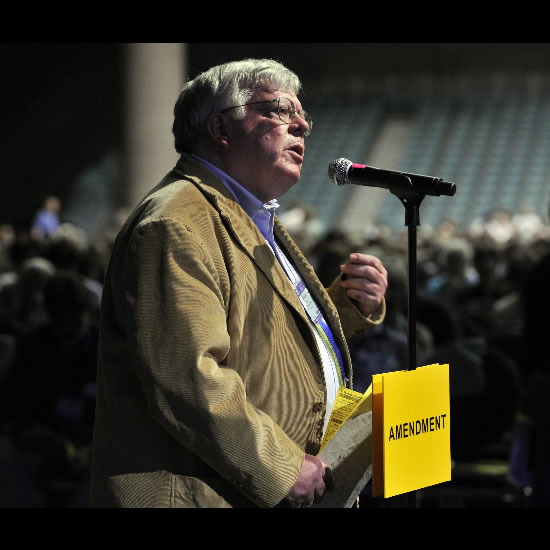
The Rev. Bob Murphy serves the Unitarian Universalist Church of Tarpon Springs, Florida. The Ethical Eating Congregational Study/Action Issue originated with Murphy and his previous congregation in Falmouth, Massachusetts. He was also instrumental in the creation of what is now the Green Sanctuary program.
The following anecdote is from a profile of Murphy that appeared in the Winter 2011 issue of UU World Magazine:
 |
| The Rev. Bob Murphy |
Becoming more aware of plastic food packaging is the first step to reducing plastic garbage. One authority on the topic is Beth Terry, author of Plastic-Free: How I Kicked the Plastic Habit and How You Can Too.
Terry's style is funny, with zero guilt. Here are the rules for her plastic trash challenge: Show Us Your (Plastic) Trash.
Terry's style is funny, with zero guilt. Here are the rules for her plastic trash challenge: Show Us Your (Plastic) Trash.
Food miles alone are not always the best guide to the greenest choices, explains this short piece in The New York Times Magazine (from 2008). Still, by striving to choose food that is free of packaging, organic, local, seasonal, low on the food chain; by finishing leftovers; and by composting our food waste, we can reduce the ecological footprint of our diet.
Watch the video "How To Lose Weight Without Losing Your Mind." The presenter, Douglas Lisle, PhD, is a practicing psychologist and co-author of The Pleasure Trap. (Scroll down for video window.) Allow 75 minutes to see the whole talk.
Do not be misled by the title; this talk is not just for those of us with weight-loss goals. It is also for those of us who have no trouble staying slender. Everyone, we hope, will benefit from watching this.
Though he never uses the term outright, "mismatch" is a main idea behind Lisle's talk. This concept comes from evolutionary biologists, who point out that the way most humans live today is "recent and abnormal," to quote Harvard professor Daniel Lieberman. In other words, we are not designed for the modern environment in which we live, and this includes our modern food supply. Our bodies come with traits that gave our ancestors a survival advantage—and yet now, those same traits can lead us astray, given our easy access to artificially-concentrated food. (Remember how Anna Lappé put it? We have an evolutionary impulse to seek fat and sugar.)
This could mean, as Lieberman explains in his new book, that obesity and other prevalent conditions such as heart disease and type 2 diabetes are best understood as mismatch diseases. We still don't have all the answers; as this Centers for Disease Control webpage indicates, researchers are currently investigating the interactions of genes and environment to gain better understanding of the obesity epidemic.
(One might wonder if Lieberman, given his field of study, promotes the so-called "paleo diet." He does not, for reasons mentioned in this interview.)
Caloric density is another main idea in Lisle's talk, and it is not new. Books like The Pritikin Principle (2000) and The Okinawa Program (2002) helped popularize the concept that food's caloric density can be key to weight management. In this talk, Lisle presents a simple, hand-drawn scale to help show the difference between various foods in terms of calories per pound.
 |
| From Douglas Lisle's talk: caloric density scale |
A few more notes, before you watch the video...
Activists in the fat acceptance movement may object that this talk begins with an oppressive premise—that there is even such a thing as "overweight." In Lisle's defense, we note that one of his anecdotes is about a patient who sets her own not-thin weight goal, reaches it, and is happy to be that size.
Furthermore, far from delivering a fat-shaming message, this talk offers a plausible biological explanation for why those of us who gain unwanted weight ought not be regarded as over-indulgent or otherwise blameworthy. And while it is not yet proven beyond any doubt that the explanation is correct, we can say it is consistent with evidence gathered thus far (such as these findings on nutrient receptors in the gut). It is a working hypothesis we deem worthy of your consideration.
For participants who have undergone bariatric surgery, a caution: at 48:50, Lisle tells about his refusal to prescribe surgery for a patient (before prescribing dietary changes). For someone who has decided to have the surgery, this may be distressing to hear. If you want to skip that anecdote, it is over by 52:00. Aside from that anecdote, do you think the concepts presented in this video are helpful for others to consider? Or can you recommend another resource you think is better? Please gift us with your feedback.
A note to cat-guardians: Lisle mentions feeding his cat, Boo, a vegan diet. Cats are obligate carnivores, so if you are wondering how this is possible and whether it is advisable, here is a book that attempts to answer those questions.
Finally, please bear with the video's technical glitches. Lisle's slides are not visible at first, but your patience will be rewarded about ten minutes into the video.
If you are using an iPad, the embedded video below is not visible to you. Instead, follow this link: http://tinyurl.com/DOVELisle
Optional assignments, if you have time:
Article: Either "Parents’ Denial Fuels Childhood Obesity Epidemic" published June 15, 2015 in The New York Times (allow 5 minutes; 1,300 words) or "The Obesity Era", published June 19, 2013 in Aeon Magazine (allow about 15 minutes; 4,700 words). Advisory: the cover image of "The Obesity Era" shows a close-up of the side of a person's body.
Videos: If you appreciated this presentation by Douglas Lisle, you may also enjoy this TEDx talk (17 min) in which he answers the question, "If we know which foods we ought to be eating, why is it so hard to do the right thing?"
 |
| From Douglas Lisle's TEDx talk: slide depicting typical pattern from exposure to hyper-stimulating food (II & III: Stimulation & Habituation) and typical pattern after removal of hyper-stimulating food (IV & V: Withdrawal & Recovery/re-habituation) |
As shown in this pair of short videos by Michael Greger, MD, "Are Sugary Foods Addictive?" (2:29 min) and "Are Fatty Foods Addictive?" (5:11 min), research has found changes in brain activity that parallel those observed in drug addiction.
click here for next session (Session A.3)

0 Comments:
Post a Comment